Panda-monium: Sixteen panda cubs pose for a class shot on their first day at nursery

Morning class: The 16 panda cubs posed for a photograph with their keepers at Wolong National Nature Reserve, in Sichuan Province, south west China


It was the first taste of independence for the youngsters at the Wolong National Nature Reserve, in Sichuan Province, south west China.

Keepers at the reserve posed for a class photograph with their wide-eyed pupils and were helping the babies adjust to their new life under the gaze of visitors at the reserve.

Around 1,600 giant pandas live in the wild in China, mostly in Sichuan and the north western provinces of Shaanxi and Gansu.

Another 290 pandas are in breeding programmes in the country.


Playtime: The wide-eyed cubs take their first wander around the playground at their new home


I want to play with that: One of the cubs admires a pink umbrella at his new home


PS While these were getting used to their new surroundings, over in the U.S. panda bear Tai Shan was getting ready to head off to China and say goodbye to 12-year-old mum Mei Xiang at the National Zoo in Washington. Under a deal between China and the U.S., all giant pandas originally from China are only on loan to foreign zoos and any cubs they produce must all return to China eventually.


Tai Shan gets covered in snow as he pulls on a branch on his final day at the National Zoo in Washington. The four-year-old is due to head to China


Slip sliding away. Tai Shan's mother Mei Xiang plays in the snow at the National Zoo in Washington


source: dailymail

Beware of the unpleasant pheasant: Locals run for cover as crazed bird terrorises village

By Paul Sims

Who are you looking at? The foul tempered pheasant which is terrorising residents in Newsham

As a tale of avian savagery it's starting to have echoes of Alfred Hitchcock's The Birds.

For months, the rural North Yorkshire village of Newsham has been terrorised by a very unpleasant pheasant - and no one has been spared.

Men, women, children, prams, bikes, dogs and even cars have all fallen victim to the psychopathic fowl, which some believe is out to avenge its dead relatives.

Victims have spoken of how the bird hides silently in bushes before leaping out and advancing on its terrified prey.

It has even chased village children after watching them get off the school bus.

There have been attempts to catch the predator but so far to no avail.

Now residents are fighting back in the hope of bringing an end to the menace on their streets.

Sonia Hall was attacked by the pheasant while out for a walk with her two-and-a-half-year- old grandson, Jacob.

The 65-year-old retired hotelier said: 'When we set off for the post office the pheasant was on the other side of the road.

'It walked all the way up the road and I pointed it out to Jacob because it was unusual for it to be following us.


Sonia Hall has spoken of her distress at being targeted by the vicious bird

'When we came out the post office and set off back to the house the pheasant darted across the road towards us.

'It started flying low towards my legs and attacked me. It was pecking at me and drew blood.

'Luckily Jacob ran further up the path to safety. It kept pecking me and I was kicking at it to try to make it stop but it wouldn't give up.'

Mrs Hall added: 'It was a horrible experience and shook me up.

'Another day it came at me and I whacked it with my handbag. I carry an umbrella round with me now for protection because I don't want to be made a prisoner in my own home.'

Her son, Charles Hall, 34, who runs the A66 Hotel near the village, said: 'People think it is getting its revenge for some of its family being shot.'

But he added: 'We had no reported sightings yesterday so maybe it's had its comeuppance.'

Bob De'Ath, chairman-of the parish council, has written-to the RSPCA and the RSPB pleading for help.

He added: 'Although it seems humorous, there is a serious concern that this pheasant could injure young children if it goes for their face.

'You can push it away, but it continues going for you.

'It is terrorising the whole village.'

Lindsay Waddell, chairman of the National Gamekeepers Organisation, said the bird was just protecting what it considered to be its home territory.

He added: 'You get a similar thing in a variety of other birds as spring approaches and the breeding season begins.'

Mr Waddell said best way to deal with the bird would be to humanely capture it and relocate it away from the village.


Under siege: The rogue pheasant has been running amok in the village of Newsham, North Yorkshire


source: dailymail

Relax! Baby gorilla takes time out from aping around

Chill time: Yewande leans back with her arms behind her head in a remarkably human-like pose

Yewande - from Calgary Zoo, Canada - decided to take this time out after spending a good half-an-hour playing with her favourite pink blanket.

In another shot Yewande's huge silverback dad Kakinga dwarfs the youngster as he wanders over to check on his chilled-out offspring.

Yewande's exploits were caught on camera by zoo visitor Nancy Chow, 66, who was amazed by the pose struck by the baby primate.

Nancy, from Alberta, Canada, said: 'When I took this shot I loved it right away because the baby gorilla was so adorable, Yewande looks so human-like.

'It is easy to see how closely we are related to these great apes, Yewande's pose could be any one of us taking a well-earned break.

'Except I don't think I could do that with my feet.


Babysitting: Dad Kakinga checks up on his daughter


'She had been playing around with her blanket just before she decided to relax.

'What was she thinking, perhaps that life is good, she is such a happy baby and well cared for.'

Nancy said that the reason for Yewande's happiness may have something to do with how many relatives she has looking after her.

She said: 'Actually when she was born Yewande's mother Zuri lost interest in the mothering department shortly after the birth.

'But the zoo keepers had stepped in to make sure Yewande was getting enough to eat, and so did three more gorillas.

'That included Yewande's big sister, five-year-old Barika who spends a lot of time with the baby.

'If both mother and sister are away, the male silverback, and father, Kakinga, will sit with the baby.'


source: dailymail

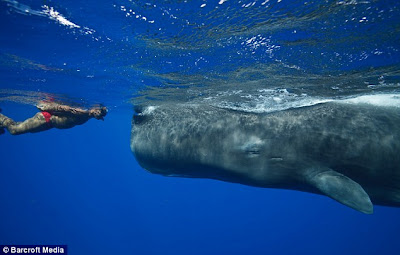
The Whale Whisperer: Astonishing bond between diver and Scar the giant sperm whale

Friends: Andrew Armour and Scar the sperm whale consider one another solemnly as they swim in the waters off Dominica last weekend

Peering solemnly nose-to-nose at each other, this is the Whale Whisperer and his friend - Scar the 10-year-old giant of the sea.

These spectacular images show Andrew Armour bonding with the colossal sperm whale in the warm Caribbean waters off the island of Dominica.

Taken on the weekend, the photographs offer stunning insight into the lives of other pod members travelling with Scar.

In one picture a large group of 'socialising' whales come together - giving the impression they are meeting up for a chat.

And in another they arrive in a perfectly formed procession - almost like they are part of an underwater military march.

The jaw-dropping series of images show how a decade spent befriending the gentle giant allows Andrew, 45, to stroke and gracefully swim alongside the 32-foot mammal.

Whale watch operator Andrew, from Dominica, said: 'Our bond began in 2000 when my wife Rhona found him injured out at sea when he was just a calf. We think he might have been attacked by pilot whales but we are not sure.

'His head and dorsal fin were injured and he came to our boat, perhaps seeking some comfort. The most we could do was pet him and his injuries left him with some scarring.


That feels nice: Scar's eyes are closed as Andrew swims alongside him petting him


'From then on he and another young female would approach us whenever they saw our boat. We could even call him over.

'Now he recognises me when I am swimming. I feel like he even knows my voice. I can get very close with him because we trust each other. I even clean lice off him and he lets me do it.

'Other whales in the area don't tend to stay in the same place when humans are around but Scar seeks interaction and seems to enjoy being petted.'

More than a decade later, Andrew is now able to invite other snorkellers and divers along to share in the incredible experience.

Last week he took underwater photographers Eric Cheng, 34, from San Francisco, California, and Tony Wu, 42, from Tokyo, Japan, to witness his amazing encounters with Scar and other sperm whales in his pod.

It meant observers Eric and Tony were given a once-in-a-lifetime opportunity to interact with the huge animal themselves.


Social functions: Other sperm whales in the pod with patches of dead skin flaking off them. Sperm whales often exfoliate by rubbing against one another


'When Tony and I first encountered Scar we had to continuously move out of the way to prevent the large whale from rubbing up against us,' said Eric.

'Soon enough, we overcame the worry that is natural when confronting one of the world's largest carnivores in its native environment.

'We stroked and scratched Scar, who twitched and rolled over repeatedly in what appeared to be enjoyment.

'It's dangerous to anthropomorphise animals - even intelligent ones - but it was absolutely clear in this case that Scar wanted the interaction.'

Anthropomorphism is the human habit of likening animal behaviour to human behaviour.

Eric continued: 'Scar can be now be approached by humans, but it is important to remember his still a wild animal and needs to be treated with respect.'


Just hanging out: Four of the whales suspend themselves upside down in the water


Captivated Tony and Eric spent three days photographing Scar and other members of the pod under the watch of experienced Andrew.

'Each day, the number of whales in the group varied,' said Eric.

'The most we have seen at one time is 13. The pods are made up of adult females, their calves, and male and female juveniles.

'When sperm whales socialise, they often come together head first. Every whale seems to be in physical contact with every other whale, and in addition to the psychological bonding contact may reinforce, their constant rubbing is also a handy way for them to remove dead skin.

'The area around each social group was filled with sheets of dead sperm whale skin, which resembles black plastic bags.

'Also striking was the repeated sonar clicks the whales used to communicate. During social encounters, the sound of rhythmic clicking was overwhelming. It felt like our bodies were shaking.'

Dominica is a small, volcanic island in the southern Caribbean and is less than two hours by plane from San Juan, Puerto Rico.

Sperm whales live in the waters around the island all year round


source: dailymail

Young leopard gets a prickly reception as it tries to eat a porcupine

Spiky reception: The two-year-old male leopard decides to make a meal of the wandering porcupine, but gets several painful spines in his paws for his trouble

This young male leopard gets a prickly reception after deciding to make a meal of a porcupine.

The big cat was left with sore paws and a bruised ego after losing out in a battle of wits with its spiny opponent.

Using all his hunting techniques, the two-year-old male tried pouncing on the porcupine from above, prodding him and trying to roll him over, but to no avail.

Undeterred, the hungry feline even tried extending a gentle paw as the porcupine shook its foot-long spines ferociously.

After 25 minutes and several painful spines in his paws, the big cat was forced to accept defeat and retreat with his tail between his legs.

The incredible moment was captured on camera by professional wildlife photographer Shem Compion in the Mashatu Game reserve, in Botswana.


Prickly customer: The leopard spent 25 minutes and exhausted his whole hunting repertoire including leaping on top of the porcupine before slinking off in defeat


Painful: The leopard got several of the porcupine's quills stuck in it as he struggled to get past its defences


Mr Compion, 33, who lives in South Africa, said: 'Excitement hardly describes my feelings - it was one of my top wildlife sightings ever.

'We saw this beautiful leopard lounging on a log and then a few moments later a porcupine walked nearby and started nibbling some roots.

'Suddenly, this relaxed leopard spotted the porcupine and sprang on to high alert, watching the rodent before getting up to stalk him.

'From then on it was full adrenaline. The leopard spent 25 minutes trying to touch the porcupine and get to him.

'The porcupine kept pushing his quills towards the cat and rattling them in a very frightening manner - the leopard would jump in shock.


Me-owww: The young leopard pulls its paw back in pain after one of the foot-long quills lodges in it


'He tried all sorts of things to get under the porcupine but nothing was working and eventually he gave up and lay down.

'There's a rule in the bush which says "only food runs", so the porcupine knew to stick around until the leopard had walked away so it could get water from a pool.

'It went from tension to suspense, pain, torment and eventually relief. It was a truly incredible sight.'

The pictures were taken during a photography wildlife safari Mr Compion was leading.


source: dailymail

From Athens to Newquay - rescued blind turtle's final journey to help save species

By Paul Harris

Airlifted to safety: Homer at the Archelon rescue centre in Athens


This probably wasn't the kind of odyssey Homer had in mind when he first came into the world as a turtle.

There were all those oceans to conquer, other turtles to meet, boundless horizons to explore.

Then he was struck blind. A terrible accident meant he could no longer feed himself, or even guess where he was going.

So yesterday he embarked his final trip across the sea - on a British Airways flight from Athens to England.

The nine stone loggerhead was airlifted to sanctuary in a remarkable operation to save the endangered species from losing another of its number - perhaps, even literally, to get the stricken creature out of the soup.

Now he could live to be 100. That was the good news. The bad news was that he'd be spending the rest of his days in Newquay.

Last night, Homer - who bears an uncanny resemblance to the Simpsons cartoon character but was actually named after the Greek poet - was preparing to begin a new chapter in his epic life in the care of marine conservationists.

He will join sharks, fish, eels, stingrays and other familiar sea life at the Cornish resort's Blue Reef Aquarium.


Namesake: The loggerhead is said to look like Homer Simpson

Newquay waters are a trifle chilly for loggerheads (and mostly populated by surfers).

So home from now on will be a 5,000 gallon tank in which he is destined to become a star attraction for hundreds of thousands of tourists a year.

Homer's 21st century odyssey began after he was injured off the Greek coast two years ago.

Experts believe he was either caught in a trawler's propeller or deliberately blinded by fishermen.

According to the Greek marine rescue centre that cared for him, fishermen have been known to gouge out turtles' eyes when they become entangled in expensive nets or destroy trawling gear.

Homer was found with a gash on his head, one eye missing and the other 'poked out'.
In different hands he might have become turtle soup. Instead, the 40-year-old reptile was taken to the centre to be cared for.

Staff spent more than a year feeding him with fish and crustaceans on a stick, later encouraging him to smell the food or feel it with his flippers so he could feed himself.

Although close to death at one stage, he gained more than 22lb and made an impressive recovery. But the centre was already crowded with other marine life. And without the power of sight, he could never be returned safely to the sea.

So the Blue Reef Aquarium, which already had links with Greece, agreed to take him on board.

Transporting a three-foot long turtle 1,500 miles across the sea, however, posed the kind of logistical problem that a loggerhead, capable of swimming thousands of miles, does not ordinarily encounter.

Which is why, last night, a British Airways jet with temperature controlled crate in the hold brought him gently into Heathrow before Homer headed west. He will be quarantined in Cornwall prior to beginning a new life in Newquay.

Blue Reef already has two loggerheads, Steve and Squirt, who were blown off course from the Canary Islands and washed up in Britain. But Homer is set to drift into retirement long after they are returned to their natural habitat.

'It's the first time we've had a turtle sent to us this way,' said deputy manager Christine Comery.

'Normally we look after them for a time and send them back to where they came from. But because he can't fend for himself he wouldn't survive.'

Homer is a particularly appropriate name because the ancient Greek writer, believed to have lived around the time of the Trojan war, is thought by some to have been blind.

Loggerheads Caretta caretta) get their name from the disproportionate size of their heads compared to their bodies.

In the wilds of the ocean, they can spend years swimming in warm currents that take them around the globe. But only rarely to Newquay.


source: dailymail

Karate buzzards fight it out in snowy Polish countryside battle

Take that: A buzzard aims a kick at the chest of his foe during a squabble in the Polish countryside

These incredible pictures show two birds of prey spectacularly fighting each other in snow like karate movie legends.

In one image a large buzzard appears to aim a deadly flying kick at its opponent's chest.

Just seconds later it seems to have floored its foe with a total knockout - leaving it spread-eagled on the ground.


Smackdown: One of the birds is toppled as victory edges ever closer


Match: The buzzard's kick resembles the infamous 'crane kick' from Karate Kid


One bird's effort during the spectacular sequence of events even resembles the infamous 'crane kick' performed by actor Ralph Macchio in hit 80s flick The Karate Kid.

The comical event was captured on camera this month by office worker Marcin Nawrocki, 33. He witnessed the acrobatic display in wintery woodland near his home in Kutno, Poland.

Wildlife lover Marcin, a hobby photographer, said: 'I have seen buzzards fight this way many times.

'They fought very spectacularly and it looked like a deadly scrap. But even after the most ferocious fight the birds just dust themselves off seem to come away uninjured.

'These two were fighting over some food, which is normally the reason why they confront each other.

'They are very territorial and were competing to claim the most meat for themselves.'

Eager to drive each other away the birds first squared up to one another with their wings fully outstretched in an impressive show of strength.

'In their stances they looked like movie martial artists getting ready for a showdown in the final scene of an action movie,' said Marcin.

Then just like screen legend Bruce Lee, the feathered fighters battled for a full minute with precision timing. They rained a series of blows on each other - mixing up their tactics like pro fighters.

In Marcin's explosive photographs they can be seen kicking, stamping and charging each other before one emerges victorious.

To get pictures this good Marcin set up a hide built by himself and then had to wait patiently in Poland's plummeting January temperatures.

'The spot where I took this is a forest popular with buzzards. It's very peaceful there with few people, so it's a great place to get amazing wildlife photography.'

Common Buzzards can be found all-year round across Europe.


Squaring up: The furious birds face each other as the battle continues


Wipeout: The victorious bird stands proudly by as his foe lies spread-eagled in the snow


source: dailymail

Same time tomorrow? Afternoon feed soars in popularity as 75 Red Kites turn up for dinner

By David Wilkes

Feeding time: 75 Red Kites circle the snowy landscape of Lampeter, West Wales

Effortlessly gliding above the snow-covered fields, these red kites know a good thing when they see it.

Food is often hard to come by in winter for the birds of prey - but not when a kindly local has set up a feeding station.

Up to 75 red kites are in on the secret and queue up for their lunch every afternoon.


Graceful: Red Kites have a wingspan of nearly two metres


Their benefactor has been feeding the birds at the undisclosed location near Lampeter in West Wales for 16 years.

So many red kites now turn up that she has to provide 28lb of chopped meat to keep them happy.

'They come rushing at me, completely surrounding me,' she said.

'I protect myself with an umbrella but if it's too windy I wear an old motorcycle crash helmet which I bought in the market for £2. Last week one walloped me on the bottom - it was sticking out more than I thought.'

The woman, who is licensed by the Department of the Environment to feed the birds, said that when she started out in 1994 she was catering for just seven.

Red kites had been hunted to the point of extinction but their numbers have recovered in Wales.

The species has been reintroduced in other parts of the UK. hen a kindly retired couple first started to feed a pair of Red Kites in 1994, they had no idea how popular their afternoon snacks would become.


source: dailymail

Battle of the elephants: Giant warriors re-enact ancient fight in Thailand


Battle of the ancients: Elephants Plai Ngathong and Plai Cocholaat with their mahouts, Toi, 30, and Ya, 27, stage an amazing fighting performance in Suphan Buri, Thailand last week


With lightning speed and military precision, they lock dusks and dodge the lethal spears carried by the warriors on their backs.

These stunning beasts are re-enacting the ancient fighting scenes of their ancestors.

The giant bull elephants have been specially trained by their skilled mahouts to fight - but the real battle is in training the elephants to know the difference between a mock clash and a real one.


The giant warriors are re-enacting the ancient fighting scenes of their ancestors for a stage production of King Naresuan, scenes depicting the king going in to battle to kill the Burmese prince Minchit Sra


'These are war scenes depicting the kings going to battle,' said Ewa Narkiewicz, from Elephantstay in Thailand.

'Our elephants are highly trained using special techniques. The idea is to show Thai people what role the elephant played in their history.'

Elephants Plai Ngathong and Plai Cocholaat are residents of Elephantstay in Ayutthaya, Thailand.

Here the 25-year-old bulls have undergone years of training to safely recreate mock fight scenes.


The two elephants, both 25, have undergone years of safety training to ensure the mock battle does not turn into a real one


The production of King Naresuan tells the story of Yuttahadhi, or the 'Elephant Battle', when the Siam King fought and killed the Burmese prince Minchit Sra on elephant back.

It features elephants, riders on horseback, hundreds of extras, fireworks and flares in a purpose built stadium near Suphanburi, 135km north of Bangkok.

Along with providing an important source of income, the work gives the elephants much-needed stimulation and pushes the skills of their mahouts.


The re-enactment is said to be helping to re-establish the mahout's position in Thai society


It is important for the mahout and elephant to develop a strong bond, so the lumbering beasts know the command to fight is really only signalling a play fight.

'If they started to fight for real they could really damage each other,' said Ewa.

She added the warrior re-enactment is helping to improve the mahout's status in Thai society.

'In the past being a mahout was an incredibly noble profession,' Ewa said.

'This is what the mahout did, they were skilled warriors. Now they are often begging on the streets and people see them as lower-class citizens.

'By doing these re-enactments we are raising the standing of the mahout back to what it was.'


source: dailymail

Can you see what it is yet? How a flock of starlings can look just like a bird, a duck and even a turtle

Birdwatching: The giant starling formation over the setting sun was spotted in Taunton, Somerset


Flocks of starlings are renowned for forming a variety of shapes in the sky.

But on this occasion they must have been overcome by vanity – and created a giant starling for us ground-dwellers to admire.

The countless creatures created the awesome display by using the winter breeze as the low-setting caused the sky to glow red.

The amazing spectacle was spotted over Taunton, Somerset.

Elsewhere, starlings created a bizarre image of a rubber duck in the sky as they flew in formation across Britain.

Animal experts have been stunned by the sight, which was spotted above home in Tolladine, Worcestershire.

Couple Thelma and Fred Stamp were amazed when they saw the feathered thousands mass above their house.

They had been racking up hours watching the skies over the past few weeks, hoping to catch a glimpse of them.


Is it bathtime? Thousands of birds create a bizarre image of a rubber duck over Tolladine, Worcestershire


Mrs Stamp: ‘We have been watching them for two weeks now and it is so lovely to see.
‘It starts with four or five of them at first but then they start coming from all around.

‘It’s been truly incredible to witness.

‘When you watch it on TV you don’t see how the birds come from different directions, at least half a dozen places - It is quite a sight.’

Starlings form a tight sphere-like formation in flight, expanding and contracting and changing shapes in what is known as a Moot.

These large flocks forage together, in a practice called roller-feeding where the birds at the back of the flock continually fly to the front to forage for food.


Shell-shocked: Starlings create the shape of a gliding turtle over the skies of Taunton


The organised technique means every bird has a turn to lead and also allows them to keep watch for predators at the same time, Alexis Johnson from the RSPB said such a massive flock of birds was a rare sight to see.

He said: 'Seeing starlings fly in these incredible formations truly is an amazing sight.

‘The birds flying together like a school of fish, all their movements in sync.
‘Because of their recent decline, it is unfortunately becoming more and more rare to see


source: dailymail