A cat's-eye view of life: Feline snapper takes photography world by storm

By DAILY MAIL REPORTER

The feline photographer: Pictures taken by the timer-operated camera worn by Cooper the cat have sold for hundreds of pounds


Ever wonder what the cat gets up to when you let it out? Well, now you know, thanks to the amazing Cooper - the feline photographer.

This moggy multimedia expert's exploits have been shedding light on the six-inch high world of cats.

Fitted with a timer-operated camera on his collar Cooper takes a picture every two minutes capturing everything from a cat's eye view.

On his exploits he catches other cats, his favourite hiding places, his human owners and even abstract sky shots all on his lens.


Making an entrance: In this picture Cooper prepares to venture out from his leafy hiding place


In one hilarious snap the moment he mocks a dog trapped behind the glass of someone's front porch is taken with almost human-like humour.

And now five-year-old Cooper is the cat who's got the cream as feline enthusiasts around the world have been lapping up his framed photos for as much as £200 a time.
Cooper's owner Michael Cross and his wife Deirdre, from Seattle, USA, decided to try out the cat camera last year.

Since then they have had two exhibitions and starting selling Cooper's work around the world

The pictures even solved a problem for Cooper after his owners saw pictures of him constantly looking at the back door - they realised he needed a cat flap.


Competition? Cooper's camera captures the latest addition to the family, baby Cameron. The Cross family plan to use a similar neck camera on their new son


Mr Cross, 32, said: 'When we first thought of putting a camera on Cooper it was simply to try to find an answer to the question that all cat owners ask: "Where does my cat go all day?"

'A geography experiment, really. We hoped that he didn't cross busy streets or go into neighbours' houses.

'When Cooper brought the camera home at the end of the first day, we were completely blown away by the stunning photography.'


Hit photographer: Michael and Deirdre Cross with Cooper the cat and some of his successful snaps


'Suddenly we no longer cared about exactly where he went, because just getting a glimpse of the beautiful images that fill Cooper's day made us realise how wonderfully lush our neighbourhood is from a cat's perspective.

'It's truly amazing to be able to see the world from a cat's perspective.

'Seeing the neighbourhood from six inches off the ground is something humans aren't used to, and it is exciting to see what cats see when people aren't around.'


Welcome to my exhibition: Cooper wears his collar-cam as his photos are put on display


Cooper now has more than 12,000 fans on the social networking site Facebook and has made TV appearances in America.


Cooper on Must Love Cats


source: dailymail, photographercat

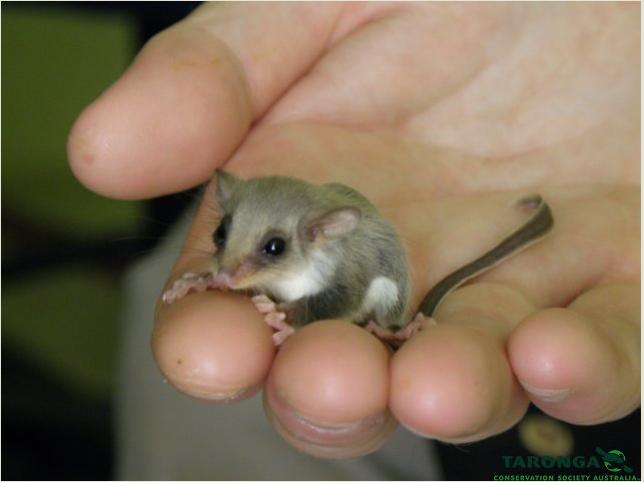
Taronga Celebrates Feather-tail Glider Births

Taronga Zoo is celebrating the breeding success of more than 20 Feather-tail Glider infants, the smallest gliding mammals in the world.

The Zoo’s Australian Fauna keepers were delighted to find 23 infant Feather-tail Gliders when checking the nest boxes and pouches of the adult breeding females. They ranged from hairless young which are about the size of a grain of rice to individuals that were just a few centimetres in length.

The infants will be out of their mothers’ pouches at approximately seven weeks of age and fully emerged from the nest box by 12 weeks of age and integrated into the colony.

When fully grown, the newborns will be about the size of a small mouse and weigh approximately the same as two to three teaspoons of water.

Feather-tail Gliders are found across the eastern seaboard of Australia. They are often mistaken for mice, but a closer inspection reveals they have a special membrane which stretches from front to rear feet that helps them glide up to 20 meters. They also have a delicate feathered tail that they use as a rudder during flight from which they get their name.

Although one of the lesser known Australian animals, the Feather-tail Glider used to feature on the one cent coin before it was taken out of circulation.

Taronga Zoo’s Feather-tail Gliders can be seen in the Zoo’s Nightlife Exhibit which brings visitors face to face with Australia’s nocturnal wildlife including Northern Quolls, Bilbies and the energetic native Plains Rats.


source: taronga.org.au

Can you see me? The pygmy seahorse who likes to blend in with the crowd

By DAILY MAIL REPORTER

Seeing red: This bright photograph of a tiny red pygmy seahorse hiding against red choral taken by Michael Gallagher won first prize in the 'macro' or close up category of the competition


It might take a closer look to figure out what the creatures are.

But these remarkable images are the winners of a prestigious worldwide underwater photography competition for amateurs.

Briton Michael Gallagher scooped first place in his category for a stunning image of a minuscule red pygmy seahorse.


Aquatic: Barracuda in the Sudanese Red Sea were snapped by Jackie Campbell while this beautiful shot of a frog perfectly reflected on the surface of a lake was taken by Luc Rooman in Belguim


As a master of camouflage, the tiny creature can barely be seen against the red coral it uses to hide from predators.

Other incredible images taken by non-professionals around the world - all shot over the past year - include the comical cartoon face of a webbed burrfish snapped by Susan Mears, from Florida, at Lake Worth Lagoon in Riviera Beach, Florida.

To qualify all of the entrants had to earn no more than 20 per cent of their earnings through photography.


Fluorescent: The magnificent colours of a Nudibranch creature stand out against the dark background in Tarragona, Spain, in this second-place photograph by Jordi Benitez


Murky depths: Groups of cuttlefish mate in waters around Holland. The picture was taken by Luc Rooman and won first place in the wide-angle category


The Annual Underwater Photography Contest is hosted by the Rosenstiel School of Marine & Atmospheric Science at the University of Miami, Florida.

A panel of experts at this year's 2011 event judged more than 600 photos from 20 countries.

Awards were given in three categories, Macro, Fish or Marine Animal Portrait, Wide Angle, and Best Overall submission.


source :dailymail

Urban birds have larger brains so they can find food in an unnatural environment

By DANIEL BATES

Big-headed: Urban birds, including the crow, have larger brains because they have to be more resourceful about finding food, scientists claim


Birds living in cities have larger brains because they have to be more resourceful about finding food, scientists have discovered.

Urban birds have to adapt to an environment that is not their natural home and find new ways of feeding themselves.

This means that over generations their brains have grown bigger as they think in new ways about how to survive.


A wren: Researchers identified 'urban adapters' as crows, wrens and tits which all come from the same family and all have larger brains compared to their bodies


The research is the first time that scientists have shown that the size of the brain is a key part of city life for avians.

The scientists identified ‘urban adapters’ as crows, wrens and tits which all come from the same family and all have larger brains compared to their bodies.

Other small-brained species such as barn swallows do survive in cities but are not true ‘adapters’, said evolutionary biology expert Dr Alexei Maklakov, the lead researcher.

‘A centre of a modern city is a novel and rather harsh environment for most species and the ability to sustain a varied diet or develop novel foraging techniques and perhaps utilise non-standard nesting places, can be beneficial,’ he said.


Rural dweller: The reed bunting is one of the species which tend to avoid cities

His team from the Evolutionary Biology Centre in Uppsala, Sweden and the Donana Biological Station, in Seville, Spain studied 82 species of birds from 22 families.

They focused their attentions on 12 cities in Switzerland and France to find out about the relationship between brain size and survival.

Family traits emerged as the key to understanding brain growth and birds from the same family were more likely to see the change.

Species which tend to avoid cities include pied flycathers, reed bunting and whitethroat.


source: dailymail

A tourist takes a snapshot of a couple of Bengal tigers


A tourist takes a snapshot of a couple of Bengal tigers presented on April 29, 2011 at the zoo of Rio de Janeiro, Brazil. The tigers were named Prince William and princess Kate after Prince William and Kate Middleton' s royal wedding in London on Friday.


A couple of Bengal tigers presented on April 29, 2011 at the zoo of Rio de Janeiro, Brazil, lie in their cage. The tigers were named Prince William and princess Kate after Prince William and Kate Middleton' s royal wedding in London on Friday.


A female Bengal tiger in her cage at the zoo of Rio de Janeiro, Brazil, on April 29, 2011.


A female Bengal tiger in her cage at the zoo of Rio de Janeiro, Brazil, on April 29, 2011.

source : daylife
photo: gettyimages

Thugly duckling

By DAILY MAIL REPORTER

Ducking out: The Jack Russell tries to get away as the tiny bird gives chase


When a tiny bundle of feathers encountered a dog it quickly became clear which one was a chicken.

A brave little duckling is seen chasing after a Jack Russell - who tries to make a dash with his tail between his legs - in a classic case of David and Goliath.

Despite the loud barks of the nervous dog, the duckling kept on running at its playmate, trying to have some fun.


All bark, no bite: Despite the loud yelps of the dog, the duckling keeps on waddling towards its playmate


The Jack Russell is so keen to get away that at one point he is seen falling flat on his face.

The duckling must have realised that this dog's bark was worse than its bite.


source: dailymail

An Asian elephant calf, born at the Oklahoma City Zoo


An Asian elephant calf, born at the Oklahoma City Zoo April 15, 2011, is pictured with her mother, Asha, right, a 16-year old Asian elephant, and her aunt, Chandra, left, a 14-year old Asian Elephant, at the zoo in Oklahoma City, Thursday, April 28, 2011.


An Asian elephant calf, born at the Oklahoma City Zoo April 15, 2011, is pictured with her mother, Asha, a 16-year old Asian elephant, in Oklahoma City, Thursday, April 28, 2011.


An Asian elephant calf, born at the Oklahoma City Zoo April 15, 2011, is pictured with her mother, Asha, a 16-year old Asian elephant, in Oklahoma City, Thursday, April 28, 2011


An Asian elephant calf, born at the Oklahoma City Zoo April 15, 2011, walks with her mother, Asha, a 16-year old Asian elephant, in Oklahoma City, Thursday, April 28, 2011.


source: daylife
photo: AP photo

It's a dog's wife: Why female pooches are 'more intelligent' than males

By DAILY MAIL REPORTER

Eye on the ball: Using an experiment involving tennis balls scientists have discovered differences in the brains of female and male dogs


If your female dog can sit, lie down and even bring your slippers then it may not just be well trained.

It could actually be all in her brain.

A study has found that female canine brains are different from that of their male counterparts.

And in at least once task the females have the edge.


No idea: Detailed analysis of the study found that male dogs did not noticed anything odd at all about the balls - yet the females did


Scientists studied a range of common household dogs of both sexes to see whether they understood a simple cognition task that humans understand by the age of one.

The task involved the realisation that objects do not change shape simply because they disappear from view.

They set up a wooden board and using a system involving blue tennis balls and used four different scenarios.


source: dailymail

Now THAT'S a bunny hop: Rabbit dressage set to take the world by storm

By DAILY MAIL REPORTER

Buggin' out: Snoopy the show jumping rabbit can jump around 60cm high


That rabbits like to hop is hardly a secret. But now European rabbit enthusiasts have harnessed their bunnies' natural talents to create a new spectator sport...
rabbit showjumping.

Invented in Sweden in the early Eighties, Kaninhop involves bunnies bouncing their way around courses consisting of several small jumps of varying height and length.

Snoopy, a black-and-white bunny from the German city of Jena, is the star of the local Kaninhop club - and he makes spends his days leaping over all manner of barricades, jumps and rails.

'Snoopy can jump 60 centimeters (about 2 feet) high,' proud Claudia Fehlen, the 23-year-old founder of the Jena bunny hopping club, told Der Spiegel.

'And he has done well in tournaments. He came in second once, and third another time.'

On the hop: Snoopy is the star of the Jena Kaninhop club


Over the past few decades to sport has spread far from its Scandinavian homeland and clubs have now sprung up in several other European countries, the U.S., Canada and even Japan.

Rules vary from country to country, but generally the more jumps a rabbit clears the higher its score. There is also sometimes a time element to competitions.


Oops! Bunnies are scored by the number of jump they can successfully clear, and there is often a time element to competition


As well as the dressage-style courses, there are also long-jump and high-jump challenges. The world height record is 99.5cm while the best distance is fully three metres, according to Swedish fan site kaninhoppning.se.

Miss Fehlen discovered the sport on the internet about five years ago. She practiced with her pet rabbits in her back garden before starting the Jena club in 2009.

Now there are 13 members who gather once a week in the eastern German city to train their animals.


Mad as a March hare: James the rabbit jumps while he is held on a leash. Trainers say restraints are vital to prevent uncontrolled breeding


Spring in his step: James easily clears another jump while training with his Jena- based Kaninhop club


Animal rights activists are alarmed by the past-time. Sweetrabbits, a private animal rights initiative in Germany, has criticised the use of leashes in Kaninhop competitions.

The group has even accused trainers of using the tethers to pull uncooperative rabbits over the obstacles.

But Miss Fehlen points out important practical reasons for keeping competing rabbits leashed: 'We use them in tournaments for safety,' she said.

'Just think of what would happen if a male were to break free. We want to avoid uncontrolled reproduction. It has happened before.'


source: dailymail

Ape close and personal: Stunning images which capture primates at their most unguarded

By DAILY MAIL REPORTER

Transfixed by the lens: Pangi, left, is a two-year-old bonobo who was born in Frankfurt Zoo. Right, other members of her family preen each other


Staring into the camera, they appear to be baring their soul.

These intimate portraits of apes at Frankfurt Zoo reveal a side of the animals rarely seen.

German photographer Volker Gutgesell has spent the past four years visiting the zoo's primate enclosure to capture the candid images.


Intimate portrait: Gorilla Rebecca, 27, has had eight babies and is also helping look after her sister Quemba to bring up her children


The 58-year-old says the years spent studying the bonobos, orangutans and gorillas has allowed him to pick up on their body language and take the perfect shot in a way few other photographers have managed.

Gutgesell started taking the images to help him cope with severe back pain caused by a slipped disc. He used to travel the world as a media manager until the injury in 2004.

Then in 2007 he developed tinnitus as a result of his injury, causing a constant ringing in his ears. But despite his condition, he has found a way of communicating through his pictures.

He said: 'I stand for many hours watching both the apes and the families that visit them.'


Eye contact: Galdikas, left, is one of four orang-utans at the zoo, and bonobo Heri, right, is also ten years old


'The more you watch them the more similarities you see between us and them.'

'Their movement is so strikingly similar to ours it becomes quite easy to read what's going on.

'Eye contact is very important - sometimes they see into the camera lens and become transfixed.

'The bonobos are funny creatures - they're my favourite.They live in a society where the males are ruled by the females.'

'So you see the males trying desperately to socialise as much as possible - by preening the females - they can't do enough for them!

'My urgent message is for us to learn from the gentle conduct of our animal relatives the primates.'


Total control: A bonobo balances a nut in her lips


Peak of his powers and recent arrival: A male gorilla and a young bonobo at the zoo

source: dailymail